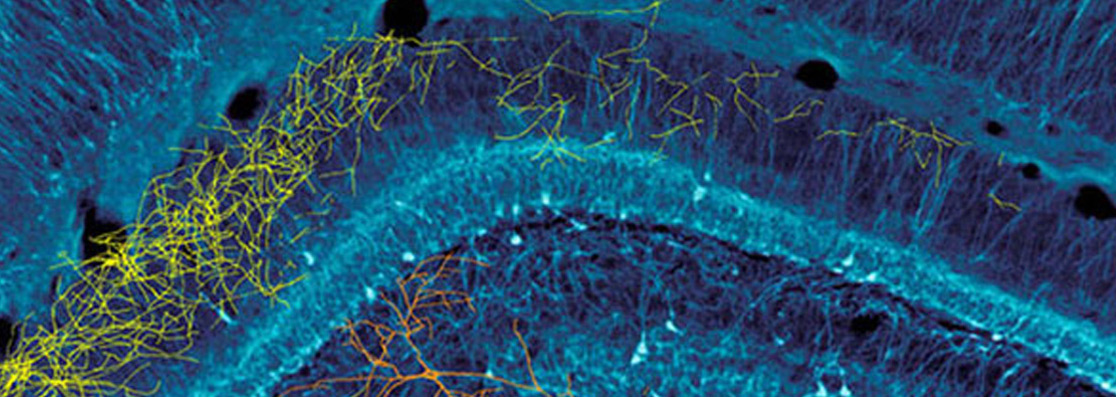
Brain image by neuroscientist and TDLC researcher Dr. György Buzsáki
Myths About the Brain
The brain is one of the most incredible organs in the human body. It controls most of the functions in our body and is comprised of around 100 billion neurons! It sends out electrical and chemical signals through nerve cells, to tell different parts of our body what to do. It also receives signals from our body, telling us what is going on around us, controlling how we react to it, and letting us think about what is happening.
The brain is so complex, that even after thousands of years of studying it, there are many areas that remain a mystery. Because of this deep mystery, brain myths have proliferated through the years. People try to simplify information about how the brain works so that we can understand it better – and myths are born.
Here are a few of the most wide-spread myths and why they are misleading:
You Only Use 10 Percent of Your Brain
So where did this idea originally come from? No one knows for sure, but many sources mention William James, an American psychologist who wrote in 1908: "We are making use of only a small part of our possible mental and physical resources" (from The Energies of Men). Through the years, this quote may have been transformed into the saying that we only using 10 percent of our brain. What data were used to come up with the number 10%? Does this mean that you would be fine if 90% of your brain was removed? It is well known that damage to a relatively small area of the brain, such as that caused by a stroke, may cause devastating disabilities.
So the 10% myth is NOT true. Brain scans have shown that no matter what we're doing, our brains are always active. In addition to billions of neurons, the brain is also full of other types of cells that are continually in use. Some areas of the brain are more active at any one time than others, but unless a person suffers brain injury, there is no one part of the brain that is absolutely not functioning. The truth is that we use 100% of our brains! |
Listening to Mozart and Other Classical Music Makes You Smarter
In recent years, parents have been tempted to buy products that incorporate classical art and music – such as Baby Einstein DVDs. They hear stories that such exposure can increase children's cognitive development. Some parents even play classical music to developing fetuses during pregnancy. This idea – that listening to classical music can increase a person’s brainpower – has become so widespread that it has been termed "the Mozart effect." So how did this myth start? In the 1950s, Albert Tomatis (an ear, nose and throat doctor) began claiming that listening to Mozart helped people with speech and auditory disorders. In the 1990s, a study at UC Irvine reported that students’ IQ scores went up by about 8 points when they listened to 10 minutes of a Mozart sonata before taking an IQ test. With these claims, the "Mozart effect" was born. Subsequently, a musician named Dan Campbell trademarked the phrase “the Mozart effect” and created books and CDs geared towards babies and children. Since then, other companies such as the Baby Einstein company, began making products for babies and toddlers incorporating classical art, music, and poetry. However recently, new research has disputed these claims, and scientists have been unable to replicate the results of the UC Irvine study. In fact, some researchers have found that these products may be doing more harm than good (eg. They could cause overstimulation, might decrease face time with human beings which is the one thing that infants most need, and they may actually delay language development in toddlers). Currently, there is no scientific information to prove that listening to classical music actually makes a person smarter. So, while listening to classical music by Mozart or other artists won’t hurt children, and may give them an appreciation for art and music, it is not likely to make them any smarter! |
The Human Brain Is the Biggest Brain
(Associated myth: The Bigger the Brain the Smarter You Are) While scientists can't agree on a single definition of “intelligence,” they generally concur that humans are the most intelligent living creature on Earth. Because of this belief, some people assume that human beings also have the biggest brains – they assume that the bigger the brain, the smarter the animal. But that is not exactly true. The average adult human brain weighs about 3 pounds – the same weight as the average brain of a dolphin (which is also a very intelligent animal). But there are animals with larger brains that are not considered to be as intelligent as a dolphin. For instance, a sperm whale has a brain that weighs about 17 pounds. On the other hand, some relatively “smart” animals have small brains – for example, dogs and orangutans: A beagle's brain is about 2.5 ounces, and an orangutan's brain is about 13 ounces. In general, the larger the animal, the larger the skull, and therefore, the larger the brain. So, back to the question: Does brain size affect an animal’s intelligence? The relationship between brain size and intelligence doesn’t have to do with actual brain weight. It has to do with the RATIO of brain weight to the entire body weight. For example, human beings have a ration of about 1-to-50. Most other mammals have a ratio of 1-to-180. For birds, the ratio is 1-to-220. So the brain takes up more weight in human beings than it does in other animals. Intelligence also has to do with the different components of the brain. Humans have the largest cerebral cortex of all mammals, relative to the size of their brains. This area houses the cerebral hemispheres, which are responsible for higher functions like memory, communication and thinking. Birds, fish and reptiles, in comparison, have smaller cerebral cortexes relative to the size of their brains. So a bigger brain doesn’t necessarily mean a smarter animal – it’s all in the ratio! |
Some People are Left-Brained, Some People are Right-Brained
This is a very popular idea. This theory suggests that the two different sides of the brain control two different “modes” of thinking, and that most of us prefer one side over the other. For example, people might view the left cerebral hemisphere as logical, verbal and analytical, while the right is seen as emotional, creative, and intuitive. These sides have been described almost as if they are two personalities in one head! But in reality, it's not as straightforward as this. To most neuroscientists, the idea that people are either left-brained or right-brained is simplistic and very misleading. Brain scanning tests reveal a more complex picture, where mental functions such as language are shared across the brain, each side contributing in a complementary way. Researchers have come to see the distinction between the two hemispheres as a subtle one of processing style, where the two sides compliment and work with each other. In fact, if one side of the brain gets damaged and can no longer perform a particular function, in some cases the other side of the brain (with a lot of practice) is able to take over that function. Researchers continue to study the subtle differences between the two halves of the brain. However, it is not true that there are people who use their "left" hemisphere predominantly or their right side. People may have a distinct preference for one style of thinking – e.g. rational vs. creative – but that has nothing to do with what side of the brain they use. The truth is we use both sides of our brains for mental functions, as one side supports the other. We use all of our brain! |
Brain Injury Is Always Permanent
When you hear the words “brain injury” or “brain damage,” it is an extremely scary thing – it means the destruction or degeneration of brain cells. To many people, this conjures images of permanent physical or mental disability. But that is not always the case; in many cases, the brain can repair itself. Even as little as two decades ago, neuroscientists believed that the brain could not make new cells. But today, using sophisticated imaging technology, scientists can see that the brain can regenerate. This process is known as neurogenesis (or “brain plasticity”). Neurogenesis is the process of forming new brain cells, and unlike what was previously thought, this process continues throughout life. Scientists are finding that the brain is able to change neurons, the organization of their networks, or their function through training and new experiences. For example, if neurons are damaged or lost, the brain can create new pathways between neurons. In addition, the brain can “reconfigure itself”: Areas of the brain that aren’t associated with certain functions can take over and allow the patient to relearn how to do things. The fact that the brain has an ability to learn by adding or removing connections, or adding cells, gives doctors and patients more hope of patients’ abilities to regain functioning after brain injury. The brain is vulnerable to many types of injuries that can be caused by anything from an infection to a car accident. How it affects someone depends on many factors, such as its location and how severe it is. The extent of injury and subsequent impairment to functions such as memory, judgment, reflexes, speech, balance and coordination cannot be easily predicted. The resulting disabilities can be treated by a number of methods, including medication, rehabilitation, surgery, physical implants, and psychotherapy. For example, stroke patients can often regain speech and motor skills through therapy. There are still many mysteries about the brain. When a person suffers a brain injury, doctors are not always able to predict how well recovery will go, and why a brain repairs itself in some situations and not in others. But one thing is certain – the new research on brain plasticity has given people hope that brain injury is not always permanent. The brain has a remarkable ability to recover after injury – sometimes even years later! |